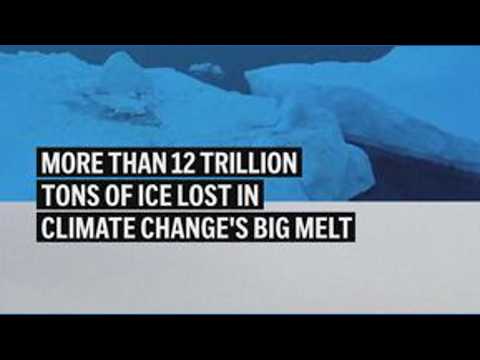
Satellites data shows loss of more than 12 trillion tons of ice from Greenland and Antarctica
.jpg)
The study, employing the longest satellite data record of changes in ice sheets ever gathered to give the most complete account to date of ice loss in Greenland and Antarctica, was conducted by the Ice Sheet Mass Balance Inter-comparison Exercise team, an international group of polar scientists. The findings, they said, offer fresh evidence of the effects of human-caused global climate change. A warming Earth is accelerating the melting of the planet’s two major ice sheets, with five-sixths of the melt not coming from hotter air, but from warmer waters eating away at the ice sheets from below and the sides, with glaciers flowing into the oceans, according to a study. That’s bad news for future sea level rise, the study’s authors said. “The ice sheets are melting away fast,” said study co-author Eric Rignot, an ice scientist at University of California, Irvine. “We are melting the polar regions, sea level is rising worldwide and will exacerbate the vulnerability of coastal regions.” The numbers behind the melting ice are both mind-bogglingly huge and deceptively small. All that melted ice turned into nearly 3 quadrillion gallons of water, which pushed global sea levels up about an inch since 1979, on top of other climate factors raising ocean heights, the report said. An inch may not sound like much, but for every third of an inch of sea level rise, another 2 million to 3 million people get flooded at least once a year, said lead study author Ines Otosaka, an ice scientist at Northumbria University in England. The Jakobshavn glacier in Greenland is now retreating up to 164 feet a day, Otosaka said. "To put this very large number into context, 11.3 trillion tons of ice is enough ice to fill in a cube that would be 23 km's (14.3 miles) in height," said Otosaka. Of the ice loss documented in the study, about 60% came from Greenland and 40% from Antarctica, even though Greenland is about one-eighth the size of Antarctica.
.jpg)
The international collaboration of polar scientists, headed by the European Space Agency, had in the past only looked at ice sheet melt since the 1990s based on European satellite data. But by incorporating NASA satellites, the scientists were able to chart ice sheet volumes in Antarctica back to 1979 and in Greenland back to 1972. "When ice sheets melt, they contribute to rising global sea levels. The ice sheets are now a major driver of sea-level rise, accounting for about 25% of all sea-level rise," Otosaka said. "We have extended our satellite data record backwards in time to the 1970s, and this confirms that ice losses started in the 1990s and have increased since then. Our assessment shows that the pace of ice loss increased by a factor of four between the 1980s and 2010s," Otosaka said. “There is a clear trend that the ice sheets are losing more mass and it has been increasing from decade to decade, especially if you look at the ice being discharged to the ocean. And that’s quite clear that there’s a link to climate change.” It showed that in the 1970s, 1980s and into the 1990s, the ice sheets were relatively stable, but then melt started happening, and it really kicked in during the 2010s, Otosaka said.
.jpg)
The study documented a slowdown in ice loss between 2020 and 2023, though the researchers said this appears to represent a short-term variation and not a reversal of the long-term trend. Unusually high snowfall across East Antarctica provided enough ice to offset some of the losses from glaciers elsewhere on Antarctica, while relatively mild summers in Greenland substantially lowered surface melting, they said. Some 84% of the ice lost came from glaciers flowing more quickly into the ocean rather than from ice melting at the surface, showing that the long-term trend is being driven by the response of the ice sheets to a warming ocean, Otosaka said. The researchers said the total sea-level rise attributed to the ice losses at Greenland and Antarctica may not sound like a huge number, but it puts another 6 to 9 million people at risk of coastal flooding and erosion globally. “That’s something to be concerned about as it shows that the changes are tracking decades behind global warming, which means we can expect them to continue for decades more, even if we are able to stop heating the planet,” said study co-author Andrew Shepherd, also of Northumbria.
.jpg)
The study’s authors said that it more reflected short-term weather variations, not long-term trends. Otosaka said the study stopped with 2023 data, but she’s looked at measurements since and found the accelerating trend has picked back up. A lot of the stability in Antarctica was because East Antarctica had record snowfall, which compensated for the rapid melting in the less stable West Antarctic Ice Sheet. The three-year hiatus was “just a bump in the record,” Rignot said. “The long rise is climate, and the threat is crystal clear.” The biggest changes scientists saw are in what they call dynamic processes, which are more abrupt and active than the slow, steady melting from the air, and that’s something prone to trigger runaway “tipping points,” Otosaka said. New York University ice scientist David Holland said that’s what concerns him “because most of the ice loss is dynamical and that is exactly what you would expect in an ice sheet instability collapse scenario.” The international team used 45 independent surveys and 27 different satellites. “The use of relatively independent methods gives me greater confidence in the result,” said Holland, who wasn’t part of the study. “The upward trend is real.”
.jpg)
“The ‘wild cards’ of Antarctic mass loss continue to pose a challenge for human management of the planet, a clear and present danger, but many decades in the future,” said University of Colorado ice scientist Ted Scambos, who wasn’t part of the study. “We are now as a society smart enough to know the future, but not prudent enough to act upon the knowledge.” These findings have implications for coastal planning, showing that we urgently need to develop plans for protecting coastal communities around the world from the impact of ice sheet melting," Otosaka said as conclusion.

.jpg)
.jpg)

No comments:
Post a Comment